SOQUEM intersects 706.6 g/t Ag, 1.27% Zn, 0.21 g/t Au and 0.28% Pb over 9.30 m on the Wagosic Detour-Selbaie Zone
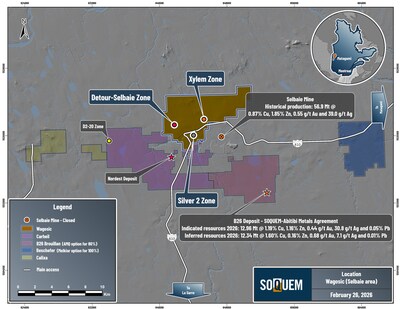
VAL-D’OR, QC, Feb. 27, 2026 /CNW/ – SOQUEM, a subsidiary of Investissement Québec, is pleased to present an update and preliminary results for the ongoing exploration drilling campaign on its Wagosic Project. The wholly owned project lies roughly 90 km west of Matagami, near the former Selbaie mine (56.9 Mt at 0.87% Cu, 1.85% Zn, 0.55 g/t Au, 39 g/t Ag; CONSOREM, 2012).
Highlights:
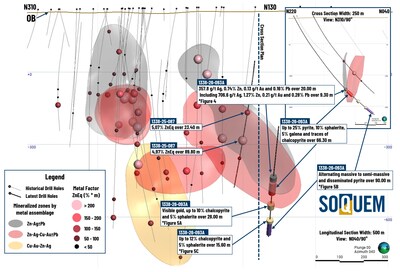
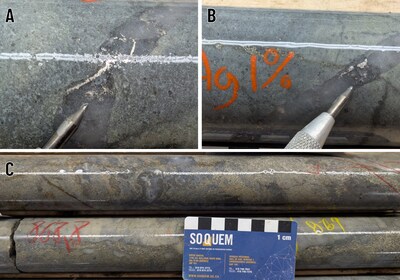
- Extension identified at a distance of 230 m from a large stockwork zone previously intersected in 2024 and 2025 on the Detour-Selbaie Zone. Hole 1338-26-093A intersected the first mineralized interval at a depth of 857.35 m, returning 357.8 g/t Ag, 0.74% Zn, 0.13 g/t Au and 0.16% Pb over 20.00 m, including 706.6 g/t Ag, 1.27% Zn, 0.21 g/t Au and 0.28% Pb over 9.30 m. The interval contains several quartz-sulphide-native silver veinlets and 1.70 m of semi-massive sulphide (pyrite-sphalerite-galena-chalcopyrite).
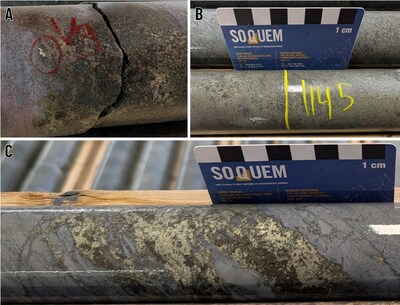
- First visible gold observed in the Detour-Selbaie Zone. Hole 1338-26-093A intersected a second mineralized interval, 28 m thick, at a depth of 1,020 m, containing up to 10% chalcopyrite, associated with a 3-mm cluster of visible gold, and up to 5% sphalerite. Mineralization occurs primarily in disseminated and stringer form.
- A new massive sulfides horizon. Hole 1338-26-093A intersected 90 m of alternating massive to semi-massive pyrite, intercalated with felsic tuffs containing up to 10% disseminated pyrite at a depth of 1,137 m. It marks the first time this type of mineralization has been encountered at this depth in the Detour-Selbaie Zone.
The exploration program of more than 16,000 m began in November 2025. As of February 26, 2026, 13 holes totalling more than 10,000 m have been drilled. Three drill rigs are active in three of the project’s key areas: the Detour-Selbaie, Silver 2 and Xylem zones (Figures 1-2). The program aims to confirm the thickness and orientation of the mineralization and extend it laterally and/or at depth. Other holes are more exploratory, testing the geological model several hundred metres from the main areas previously investigated.
The objective of the 2025-2026 program is to begin developing the Detour-Selbaie and Silver 2 zones, with an initial assessment of their mineral potential scheduled for 2027. Metallurgical testwork is underway on three selected mineralized intervals from the 2025 holes: two from the Detour-Selbaie Zone and one from the Silver 2 Zone.
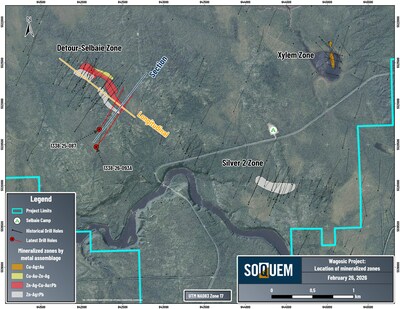
Preliminary results for hole 1338-26-093A from the current drilling program are presented in Table 1. All other results are pending. This hole intersected the mineralization encountered in hole 1338-25-087 (2.66% Zn, 0.42% Cu, 0.11 g/t Au and 18.9 g/t Ag over 89.8 m, press release dated October 20, 2025) at a distance of approximately 230 m (Figures 2-3). The intersected polymetallic mineralized intervals are consistent with the expected extension of the mineralized zones in hole 1338-25-087 (Figures 3-4-5). The mineralization occurs within a felsic sequence composed of rhyolites and tuffs, with a combined thickness exceeding 300 m. The rhyolite contains up to 25% pyrite, 10% sphalerite, 5% galena and traces of chalcopyrite in multiple decimetric intervals, locally metre-scale. The felsic tuff following the rhyolite contains up to 10% chalcopyrite and 5% sphalerite. In both cases, mineralization is mainly in the form of centimetric to decimetric stringers and disseminated sulphides. Additional holes will be drilled during the current program within a radius of 150 to 200 m around hole 1338-25-087.
An electromagnetic survey will test some of the deepest holes to define targets for the next phase of exploration, scheduled for the winter of 2027. Historically, only holes reaching a vertical depth of 650 m or more have generated anomalous responses prospective for copper mineralization.
Table 1. Analytical results from hole 1338-26-093A – Wagosic Project
|
Area |
Hole |
From |
To |
Length1 |
Zn |
Ag |
Pb |
Cu |
Au |
ZnEq2 |
AgEq2 |
|
Detour- |
1338-26-093A |
859.0 |
879.0 |
20.0 |
0.74 |
357.8 |
0.16 |
0.03 |
0.13 |
12.79 |
394.5 |
|
incl. |
859.0 |
868.3 |
9.3 |
1.27 |
706.6 |
0.28 |
0.05 |
0.21 |
24.92 |
768.4 |
|
1Intervals are presented as drill core lengths. |
|
2Grades are expressed as % ZnEq and g/t AgEq in situ. Metal prices (USD) used in the calculations: Ag: $30/oz; Au: $2,500/oz; Zn: $1.35/lb; Cu: $4.50/lb. Pb was not considered. |
About Wagosic
Wagosic, one of SOQUEM’s flagship projects, is currently at the exploration drilling stage, with a program planned for winter 2026. It is being explored after a 3D lithostratigraphic interpretation revealed a weakly deformed, shallow-dipping sequence cut at a high angle by hydrothermal systems displaying zoned mineralization. These systems show a relationship between VMS (volcanogenic massive sulphide) and epithermal mineralization:
- Concordant VMS hydrothermal mineralization, mainly (argentiferous) pyrite, locally rich in zinc and lead, is present in exhalative horizons.
- Epithermal-style hydrothermal mineralization, in the form of zinc- and silver-bearing stockworks and/or disseminations, with local copper, gold and lead enrichments, has been documented below the exhalative horizons.
- Hydrothermal mineralization in the form of copper- and gold-rich veins and breccias occurs at depth.
Main zones
The Detour-Selbaie Zone is located within a vast volcano-sedimentary sequence composed of rhyolite, felsic tuff, dacite, intermediate tuff and andesite. This area is characterized by widespread carbonatization, whereas the core of the stockwork system displays strong silicification accompanied by a gradual increase in the sericite-chlorite assemblage with depth. The entire VMS-epithermal hydrothermal system is represented. To date, the mineralized system measures more than 800 m in width and extends more than 900 m in depth (Figure 3). The mineralized zones, sometimes imbricated, range in thickness from a few metres to several tens of metres.
The Silver 2 Zone is hosted in a thick felsic tuff unit of dacitic affinity, located below the massive pyrite exhalative horizon. The tuff displays pronounced silicification (SiO2 > 85%) and is cut by a stockwork zone where most of the silver content is concentrated. At least two generations of veins and veinlets have been identified: the first is characterized by an assemblage of pyrite, sphalerite, galena ± native silver, while the second is dominated by quartz, with varying proportions of the same sulphides. The mineralized zone is at least 400 m long and 160 m wide. Its thickness varies significantly, ranging from several tens of metres at its northern limit to only a few metres on its southern side.
Other drilling program – Lespérance-Lac Shortt Project
In February, SOQUEM also completed a 4,473-m drilling program on its Lespérance-Lac Shortt gold project, advantageously located between the closed Bachelor and Lac Shortt mines. Initial observations confirm an extension of the previously identified mineralized zones. The results will be announced in the coming weeks.
Analytical Protocols
Strict QA/QC protocols were implemented, including the insertion of certified reference material and blanks. All samples were sent to Activation Laboratories Ltd (Actlabs) in Val-d’Or for preparation and analysis.
Samples were weighed, crushed, pulverized, dissolved using the 4-acid method, and analyzed by ICP-MS/OES for 48 elements. For Cu, Zn and Pb grades exceeding 1%, the sample was re-assayed by 4-acid digestion followed by ICP-OES analysis. For Ag grades exceeding 100 ppm, 50 g of the pulp was re-assayed by fire assay with a gravimetric finish.
For gold (Au), 50 g of material was analyzed by fire assay with atomic absorption spectrometry (AAS) finish. Samples grading over 5.0 g/t Au were systematically re-assayed by gravimetry using pulp material.
Qualified Person
The technical information in this press release has been reviewed by Catherine Jalbert, geologist and vice-president of SOQUEM, who is a qualified person as defined by National Instrument 43‑101.
About SOQUEM
SOQUEM, a mineral exploration company and subsidiary of Investissement Québec, is dedicated to exploring, discovering and developing mineral resources in Quebec. SOQUEM also helps maintain strong local economies. Proud partner and ambassador for the development of Quebec’s mineral wealth, SOQUEM relies on innovation, research, and strategic minerals to guide its future actions.

SOURCE Soquem inc.