Quimbaya Gold Defines a Copper-Molybdenum Porphyry System at Tahami Center
All six holes intersected a large geochemically anomalous metal-bearing porphyry system. Data is currently being modelled to test whether vectors toward higher-grade portions of the system can be defined.
Vancouver, British Columbia–(Newsfile Corp. – October 16, 2026) – Quimbaya Gold Inc. (CSE: QIM) (OTCQX: QIMGF) (FSE: K05) (“Quimbaya” or the “Company”) reports assay results from the first six holes of its drill program at Tahami Center, part of the Company’s Tahami Project in Segovia, Antioquia, Colombia.
The six holes reported here, totaling 2,928 meters, were sampled from surface to end of hole. All six intersected the copper-molybdenum porphyry system, with geochemically anomalous but sub-economic mineralization present in every hole. On completion of the current phase of drilling the Tahami Center drill program will be paused so that the data can be evaluated and modelled, while the Company’s drilling continues at Tahami South Gold-Silver target. At the same time, surface exploration will resume at the northern end of the porphyry system and, given the tendency for porphyry deposits to occur in clusters, a generative stream sediment sampling program and magnetic survey will be carried out to identify whether other near-surface porphyry targets exist.
Summary
-
All six holes intersected the Tahami Center porphyry system. Sulphide mineralization is continuous below a leached and oxidized zones cap.
-
Grades are geochemically anomalous but sub-economic. Below the oxide zone the six holes average 0.021% Cu and 31 ppm Mo.
-
TCDH-006 returned 526.95 meters grading 0.041% Cu and 34.1 ppm Mo from 131.90 meters to the end of the hole, including 98.70 meters grading 0.062% Cu from 533.75 meters and 21.25 meters grading 0.072% Cu from 501 meters (including 9.6 meters at 0.1% Cu).
-
Metal zoning is consistent with a porphyry system: in the pooled data molybdenum peaks between 100- and 200-meters depth and the Cu/Mo ratio then rises with depth, from 3.6 at 100-200 meters to 26.4.
Commentary of the Senior Technical Advisor
Dr. Stewart D. Redwood, PhD, FIMMM, FSEG, Senior Technical Advisor to Quimbaya Gold, who confirmed the Tahami Center porphyry system identified by the Company’s Exploration team, said during his review of the drill core on site from September 11 to 13, 2026:
“The Tahami Center porphyry copper-molybdenum project is significant as the first porphyry system to be discovered in the Segovia gold belt of Jurassic to Cretaceous age. It is rare to find an outcropping porphyry system nowadays. It was discovered in outcrop in a well-explored area but it had not previously been recognized which highlights the discovery potential of Colombia.
I visited the project on September 11 to 13 to review the drill core. The project has the characteristics of a typical porphyry copper-molybdenum deposit. I was impressed by the size of the system and the strength of the alteration and stockwork veining. However, the percentage of copper sulphides is low and they mostly comprise chalcopyrite, with only traces of bornite. This is reflected in the low copper grades intersected so far. The holes are mineralised from top to bottom but the grades are sub-economic. The potassic alteration zone is exposed at surface which indicates a moderately deep level of the porphyry system. It is partly overprinted by quartz sericite, and also by advanced argillic alteration in the root of the lithocap. The company awaits the results of the final holes in order to complete the interpretation of the results and to model the geometry of the system to look for evidence and vectors that may indicate possible zones with higher copper and molybdenum grades. These could include deeper zones of the potassic core, early mineral porphyry stocks, magmatic-hydrothermal breccias, the carapace and cupola zones of the intrusions where vein density is highest, and enrichment zones in or below the lithocap, amongst others.
Tahami Center is a large porphyry system that has only been tested by six holes to date, with results for three more pending. In many porphyry systems economic grades were not discovered until many more holes had been drilled. Examples are Nuevo Chaquiro (Colombia), Oyu Tolgoi (Mongolia), and Vendaval (Argentina).
Porphyry deposits often occur in clusters and, I recommend that Quimbaya Gold use its first-user advantage to carry out a rapid reconnaissance exploration program of its extensive tenement position at Tahami by stream sediment survey and drone magnetic survey to explore for additional porphyry targets.”
Management Commentary
Alexandre P. Boivin, President and Chief Executive Officer, commented:
“This was an initial test of a system we had only ever seen from surface, and its purpose was to find out what is actually there at depth. There is a large porphyry system at Tahami Center with the full alteration and veining architecture you would expect, mineralized in every hole drilled. We also know the grades are sub-economic, and they came in below what the core had suggested to us. The remaining holes will finish this phase. We will then pause at Tahami Center to model everything we have learned and look hard for vectors to higher grade, while our drilling continues at Tahami South. We will also take what this system has taught us out across the rest of our ground, because porphyry deposits rarely occur alone.”
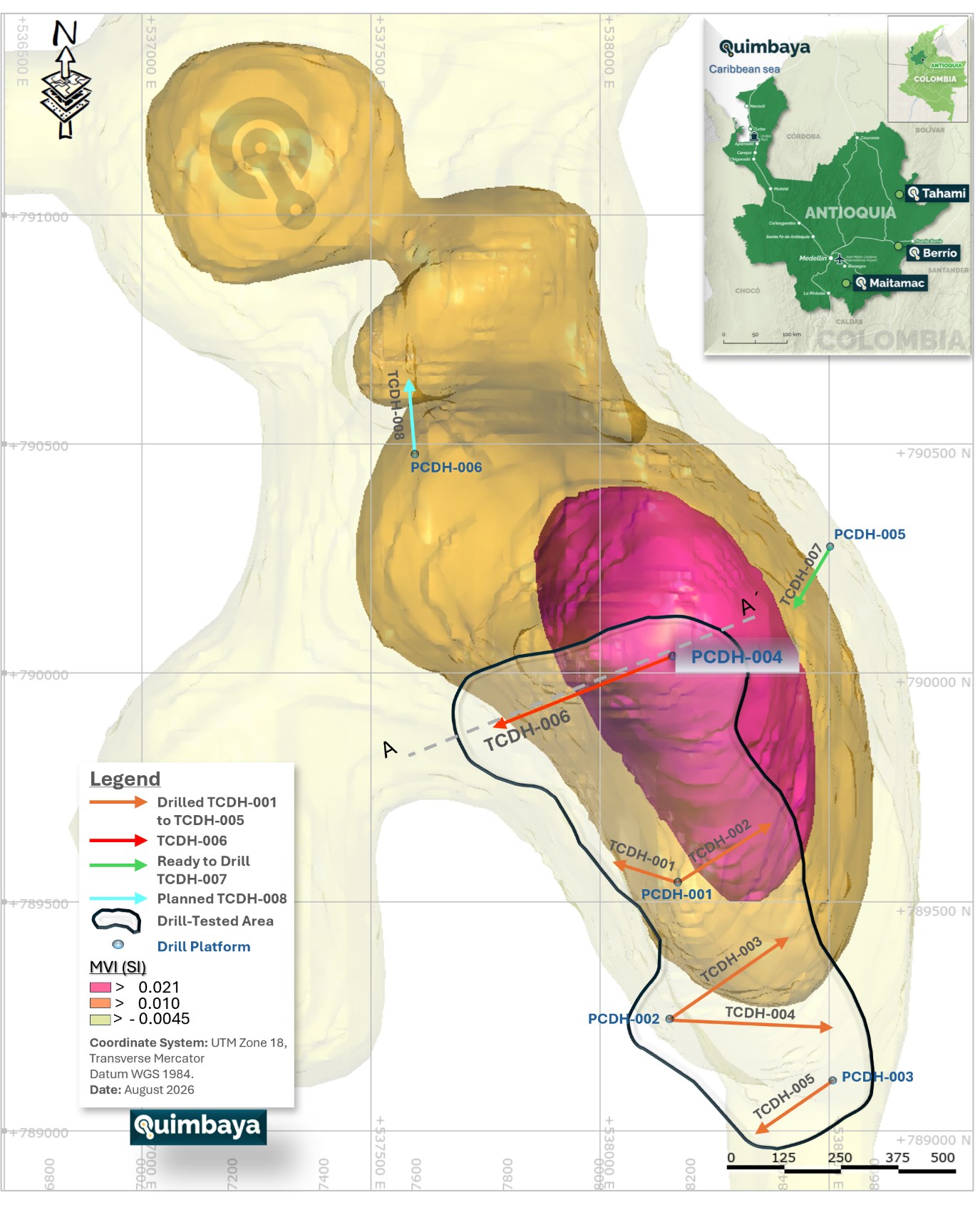
Figure 1. Three-dimensional Magnetic Vector Intensity model and drill collar locations, Tahami Center drill program, as at August 17, 2026. The black outline denotes the area tested by the six holes reported here; holes labelled ready to drill or planned reflect the program at that date. Section line A to A prime is shown in Figure 2.
To view an enhanced version of this graphic, please visit:
https://images.newsfilecorp.com/files/11347/319272_3289143d949fba1d_001full.jpg
The Program
The program was designed as an initial test of the approximately 3.1 by 1.3 kilometer Tahami Center porphyry copper-molybdenum system as defined by surface mapping, soil and rock geochemistry, 3D Magnetic Vector Intensity modeling and radiometric data. The six holes reported here were drilled from four platforms between May 22, 2026 and August 18, 2026, for a total of 2,928 meters (Figure 1). The average hole depth was 488.0 m and varied between 294.30 m (TCDH-001) and 658.85 m (TCDH-006). Drilling has continued since August 17, 2026.
The holes were designed to establish the grades of the porphyry copper-molybdenum system, to map its architecture, alteration and mineralization zoning, and to identify vectors toward the centers of mineralization. A total of 1,779 core samples over 2,925.55 meters were assayed for gold by fire assay (FAA313) and for copper, molybdenum, silver and a multi-element suite by four-acid digestion with inductively coupled plasma analysis (ICP-AES), representing continuous sampling of every hole from top to bottom other than 2.35 meters of core in TCDH-004 that was not recovered.
Assay Results
All six holes intersected anomalous copper-molybdenum mineralization. Results are reported in Table 1 as mineralized envelopes, being intervals at or above a 0.02% copper cut-off, with higher-grade included intervals at or above a 0.05% and 0.07% copper. Over the 2,925.55 meters sampled, the six holes average 0.02% Cu, 30 ppm Mo and 0.016 g/t Au. Below the oxide zone they average 0.021% Cu, 31 ppm Mo over 2,717.60 meters.
| Hole ID | From (m) | To (m) | Length (m) | Cu (%) | Mo (ppm) | Au (g/t) |
| TCDH-001 | 264.80 | 294.30 | 29.50 | 0.036 | 38 | 0.012 |
| TCDH-002 | 69.70 | 174.70 | 105.00 | 0.022 | 37 | 0.018 |
| 185.50 | 293.35 | 107.85 | 0.032 | 36 | 0.012 | |
| including | 243.70 | 262.70 | 19.00 | 0.056 | 36 | 0.012 |
| 309.20 | 367.95 | 58.75 | 0.030 | 54 | 0.011 | |
| TCDH-003 | 179.70 | 240.75 | 61.05 | 0.026 | 93 | 0.012 |
| 360.50 | 439.10 | 78.60 | 0.029 | 28 | 0.023 | |
| 467.00 | 518.05 | 51.05 | 0.027 | 17 | 0.035 | |
| TCDH-004 | 275.05 | 454.25 | 179.20 | 0.035 | 27 | 0.015 |
| including | 321.35 | 333.20 | 11.85 | 0.058 | 25 | 0.023 |
| TCDH-005 | 0.00 | 130.00 | 130.00 | 0.024 | 24 | 0.016 |
| 366.30 | 391.05 | 24.75 | 0.024 | 25 | 0.013 | |
| TCDH-006 | 131.90 | 658.85 | 526.95 | 0.041 | 34 | 0.015 |
| including | 290.90 | 319.65 | 28.75 | 0.057 | 40 | 0.019 |
| including | 501.00 | 522.25 | 21.25 | 0.072 | 38 | 0.028 |
| and including | 501.00 | 510.60 | 9.60 | 0.100 | 18 | 0.030 |
| including | 533.75 | 632.45 | 98.70 | 0.062 | 28 | 0.015 |
| and including | 601.80 | 626.45 | 24.65 | 0.079 | 25 | 0.014 |
| including | 641.35 | 652.70 | 11.35 | 0.053 | 20 | 0.015 |
Table 1. Mineralized envelopes are length-weighted composites of contiguous samples at or above a cut-off of 0.02% copper, permitting a maximum of 10 meters of internal dilution below cut-off and a minimum composite length of 20 meters. Every interval in the six holes meeting those parameters is reported. Included intervals are selected higher-grade intervals at or above a cut-off of 0.05% copper with a maximum of 6 meters of internal dilution; all those at least 10 meters long are reported. Second -order included intervals (“and including”) are at or above 0.07% copper with a maximum of 4 meters of internal dilution and are a selection. All grades are uncut. Reported lengths are downhole core lengths; true widths are not known. No metal equivalent value is reported. Silver is not reported in the table: it is at or near the detection limit in all but 19 of the 1,779 samples, and the highest value returned, 42 g/t over 2.0 meters in TCDH-004 from 4.0 meters, lies within the oxidized near-surface zone.
Alteration Zoning and Metal Vectors
A leached, oxidized cap is developed in every hole, extending to vertical depths below the collar of 4.8 meters in TCDH-002 to 78.2 meters in TCDH-001. Within the cap the holes average 0.009% Cu; below it they average 0.021% Cu. Copper is lower in the cap than in the underlying sulphide zone in five of the six holes, consistent with leaching, and surface geochemistry may understate the hypogene mineralization beneath it.
Pooled across the six holes and averaged in 100-meter downhole intervals (Table 2), the metal zoning is consistent and vectors downward:
| Downhole interval (m) | Cu (ppm) | Mo (ppm) | Cu/Mo | Cu/Zn |
| 0 – 100 | 107 | 21 | 5.1 | 3.8 |
| 100 – 200 | 141 | 39 | 3.6 | 5.4 |
| 200 – 300 | 219 | 35 | 6.2 | 7.5 |
| 300 – 400 | 251 | 31 | 8.1 | 6.0 |
| 400 – 500 | 252 | 29 | 8.7 | 5.7 |
| 500 – 600 | 297 | 19 | 15.2 | 4.4 |
| 600 – 659 | 586 | 22 | 26.4 | 13.1 |
Table 2. Length-weighted averages of all 1,779 samples from TCDH-001 to TCDH-006, pooled and binned by downhole depth of the sample start. Cu/Mo and Cu/Zn are elemental ratios calculated from those averages. Only three holes extend below 500 meters.
Copper increases more than fivefold with depth, while molybdenum peaks between 100- and 200-meters depth and then declines. The Cu/Mo ratio consequently rises from 5.1 to 26.4.
The pattern is clearer in TCDH-006, where copper rises from 0.015% in the uppermost 100 meters to 0.060% below 600 meters. This hole, which is the northernmost, also has the highest hole-average copper (0.035% Cu, against 0.008% to 0.021% Cu in the other five holes); with six holes that spatial relationship is indicative rather than established.
TCDH-006: The Deepest Hole, Ending in the Most Anomalous Grades
TCDH-006 is the deepest hole of the program. It was drilled with an azimuth of 245 degrees at an inclination of -55 degrees, to a total depth of 658.85 meters (Figures 1 and 2).
The copper grade generally increases with depth, from an average of 0.015% Cu in the uppermost 100 meters to 0.060% below 600 meters. The hole was completed at its planned depth and ended in mineralization.
The assay results are consistent with the alteration zoning reported on September 8, 2026. Potassic alteration comprising potassium feldspar with secondary biotite and magnetite is the dominant alteration from approximately 96 meters to the end of the hole, a downhole interval of approximately 563 meters. The Company interprets the holes drilled to date as having tested the potassic zone of the system at depths consistent with the exploration model.
TCDH-007, currently in progress, is being drilled from a separate platform approximately 420 meters northeast of TCDH-006 collar to test the upper portion of the high-intensity magnetic anomaly beneath and east of the TCDH-006. (Figure 2).
Readers should note that grade and depth together govern whether a porphyry system can be economic. The grades intersected to date are sub-economic, and mineralization at the depths tested would require substantially higher grades than those returned to be of economic interest.
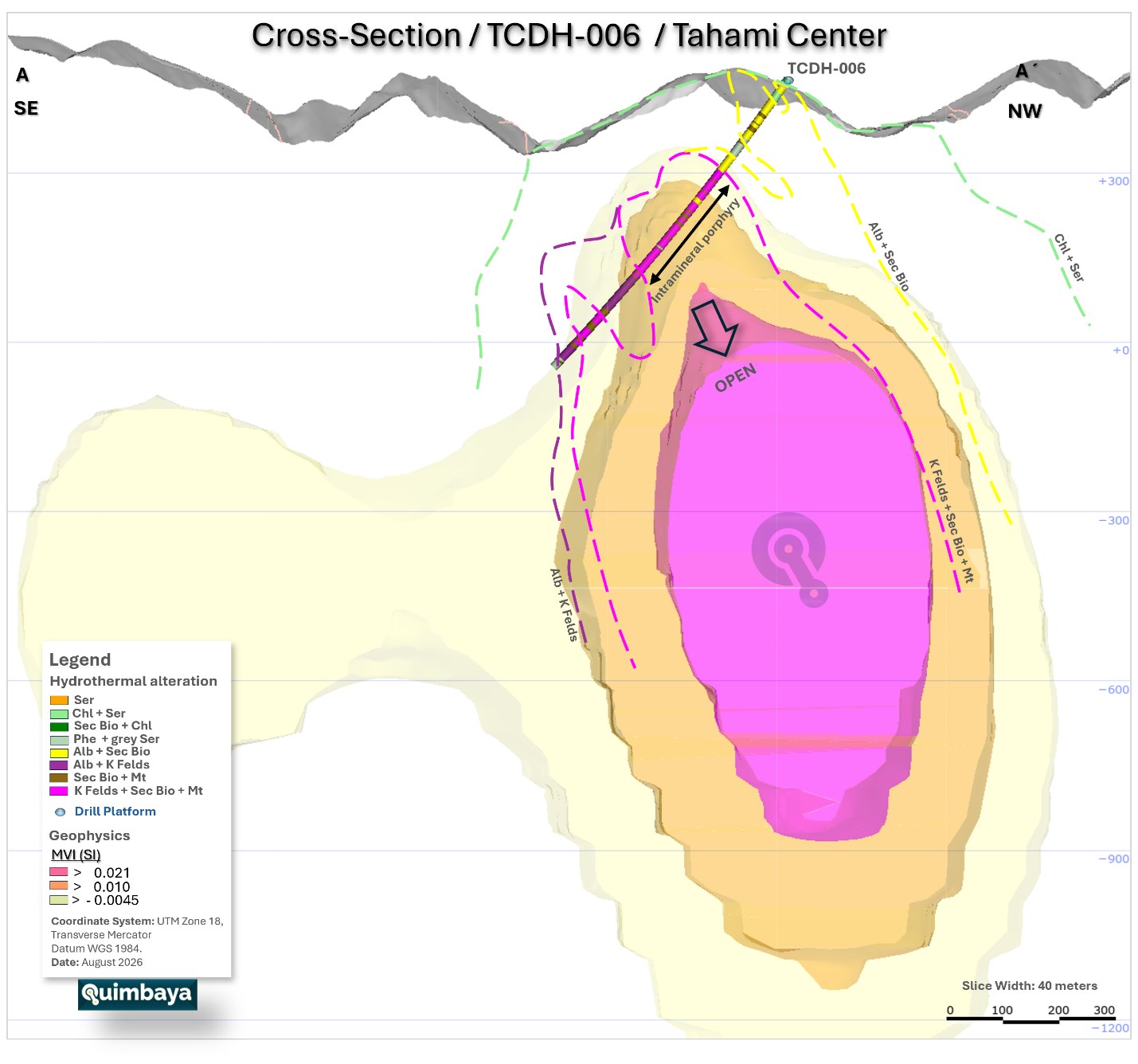
Figure 2. Cross section of drill hole TCDH-006, Tahami Center drill program, as at August 2026, showing hydrothermal alteration zoning and Magnetic Vector Intensity. K felds = potassium feldspar; Sec Bio = secondary biotite; Mt = magnetite; Alb = albite; Phe = phengite; Ser = sericite; Chl = chlorite; MVI = Magnetic Vector Intensity. Quimbaya Gold Inc., 2026.
To view an enhanced version of this graphic, please visit:
https://images.newsfilecorp.com/files/11347/319272_3289143d949fba1d_002full.jpg
TCDH-001 to TCDH-005
Each of holes TCDH-001 to TCDH-005 returned continuous anomalous mineralization (Table 1). TCDH-001, which was abandoned at 294.30 meters after the drill rods became stuck, ended in mineralized breccia and intermineral porphyry and records the steepest downhole increase of the program, its lower half averaging six times the copper grade of its upper half.
Next Steps
The Tahami Center drill program will be paused on completion of the current phase of drilling, so that the results of the full program can be evaluated and modelled. The Company’s drilling continues at Tahami South. The evaluation will test whether vectors toward higher-grade portions of the system can be defined.
Surface exploration will resume at the northern end of the porphyry system in Q1 2027. In addition, given the tendency for porphyry deposits to occur in clusters, a generative stream sediment sampling program and drone magnetic survey will be carried out on the Company’s tenements to the north, commencing in Q1 2027, to identify whether other near surface porphyry targets exist.
Sampling, Analytical Method and Quality Control
Drill core was logged and photographed by Company personnel under the supervision of the Qualified Person. Core samples were collected from half core intervals in HQ3 and NQ3 drill core over nominal two-meter sample lengths ranging from 0.5 to 2.0 meters, with cuts oriented as close as possible to perpendicular to the observed structural fabric. Sample weights typically ranged from approximately two to three kilograms. Samples were submitted to SGS, an ISO 17025 accredited laboratory independent of the Company. Gold was determined by fire assay with atomic absorption finish (FAA313). Copper, molybdenum, silver, lead, zinc and a multi-element suite were determined by inductively coupled plasma analysis (ICP40B). A total of 1,779 core samples over 2,925.55 meters were analyzed, representing continuous sampling of each of the six holes from surface to end of hole other than 2.35 meters of core in TCDH-004 that was not recovered.
Quimbaya has implemented a quality assurance and quality control program that includes the regular insertion of certified reference materials, blanks and field duplicates into the sample stream at an approximate rate of 15 to 20%. The Qualified Person has reviewed the quality control results for the program and considers them to be within acceptable limits for the purposes of this news release. Reported lengths are downhole core lengths; true widths are not known.
About Quimbaya
Quimbaya Gold is a Colombia-focused exploration company advancing a district-scale portfolio of more than 73,000 hectares across highly prospective mineral belts in Antioquia, Colombia. Its flagship Tahami Project, located in Segovia, is immediately adjacent to a prolific high-grade gold mining camp, while the Berrio and Maitamac projects are strategically positioned in Puerto Berrío and Abejorral, respectively. Early-stage exploration has identified mineralized vein systems and documented features consistent with a multi-commodity porphyry system prospective for gold, copper and molybdenum, highlighting the district-scale discovery potential of Quimbaya’s land package. The Company is led by a proven technical and management team committed to disciplined exploration and responsible mining practices.
Contact Information
Alexandre P. Boivin, President and CEO [email protected]
Sebastian Wahl, VP Corporate Development [email protected]
Quimbaya Gold Inc.
Follow on X @quimbayagoldinc
Follow on LinkedIn @quimbayagold
Follow on YouTube @quimbayagoldinc
Qualified Person
Ricardo Sierra, AusIMM, is a non-independent Officer “VP Exploration” and the Qualified Person for this news release. The scientific and technical content of this press release has been reviewed and approved by Mr. Sierra, who has sufficient experience with South American exploration projects relevant to the style of mineralization and type of deposit under consideration. He has verified the data disclosed herein and consents to the inclusion of the Exploration Results in the form and context in which they appear. Mr. Sierra supervised the drill program and verified the collar, survey, logging and photographic data by direct examination of drill core, and the analytical data by review of the original laboratory certificates. Reported lengths are downhole core lengths and true widths are not known. This news release refers to nearby or adjacent mines, deposits and operations, and to other mineral deposits elsewhere that are named by way of geological analogy only; that information is derived from public sources, the Company has no interest in any of those properties, and mineralization on those properties is not necessarily indicative of mineralization on the Company’s properties.
Cautionary Statement Regarding Forward-Looking Information
This news release contains “forward-looking information” and “forward-looking statements” (collectively, “forward-looking statements”) within the meaning of applicable Canadian securities legislation, including statements regarding: the completion of the current phase of drilling at Tahami Center; the anticipated conclusion of the current Tahami Center drill program; the receipt, evaluation and modelling of outstanding assay results; the interpretation of geological, geochemical and geophysical data, including potential vectors toward higher-grade mineralization; planned surface exploration, stream sediment sampling and magnetic surveys and their potential to identify additional porphyry targets; and the Company’s exploration plans generally. Forward-looking statements are frequently identified by words such as “plans,” “expects,” “anticipates,” “intends,” “potential,” “may,” “will” and similar expressions.
Forward-looking statements are based on assumptions the Company considers reasonable, including that exploration activities will proceed as planned; that drill rigs, qualified personnel and laboratory services will remain available; that the Company will have access to sufficient capital; that required permits and approvals will be obtained; that relationships with local communities and other stakeholders will remain favourable; and that the geological, geochemical and geophysical interpretations relied upon accurately reflect subsurface conditions.
Forward-looking statements are subject to known and unknown risks that may cause actual results to differ materially, including: risks inherent in mineral exploration, including that results may be poorer than anticipated and that further exploration may not identify economic mineralization; the accuracy of geological interpretations and assay results; fluctuations in metal prices, currency exchange rates and capital markets; the Company’s ability to obtain financing; permitting and regulatory risks; risks of operating in Colombia, including security, political, community and social-licence risks and artisanal mining activity; title and tenure risks; reliance on key personnel and contractors; and the other risks described in the Company’s continuous disclosure filings available under its profile on SEDAR+ at www.sedarplus.ca.
Forward-looking statements are made as of the date of this news release. Although the Company believes the expectations reflected in them are reasonable, there can be no assurance that they will prove accurate, and readers are cautioned not to place undue reliance on them. Except as required by applicable securities laws, the Company undertakes no obligation to update or revise any forward-looking statement.
Cautionary Note Regarding Exploration Results and Mineralization
The scientific and technical disclosure in this news release has been prepared in accordance with the Canadian regulatory requirements set out in National Instrument 43-101 – Standards of Disclosure for Mineral Projects (“NI 43-101”) and the Canadian Institute of Mining, Metallurgy and Petroleum (CIM) Definition Standards for Mineral Resources and Mineral Reserves adopted by CIM Council on May 10, 2014. Exploration results disclosed in this news release, including soil, rock, channel, and drill sampling results, do not constitute a mineral resource or a mineral reserve as defined under NI 43-101 and the CIM Definition Standards, and readers should not assume that any mineralization disclosed herein will ever be delineated as a mineral resource or a mineral reserve. Sample lengths and intercepts reported in this news release represent the interval measured in the drill hole, channel, or along the sampled surface, and do not necessarily represent the true width of mineralization. There is no certainty that further exploration will result in the discovery or definition of a mineral resource or a mineral reserve on any of the Company’s mineral properties.
NOT FOR DISTRIBUTION TO UNITED STATES NEWS WIRE SERVICES OR FOR DISSEMINATION IN THE UNITED STATES

To view the source version of this press release, please visit https://www.newsfilecorp.com/release/319272