Molex Forecasts Top 10 Connectivity and Electronics Predictions for 2027: Powered by AI, Simulation-First Engineering and System-Level Optimization
- Digital engineering: AI, digital twins, simulation, connected data and automated workflows will transform product development
- Modular architectures: Platform strategies and co-design approaches will scale across aerospace and defense, automotive, data center, industrial and medical sectors
- Cross-industry tech convergence: Technology transfers will unlock unprecedented leaps in reliability, ruggedization and miniaturization
LISLE, Ill., Nov. 10, 2026 /PRNewswire/ — Molex, a global electronics leader and connectivity innovator, predicts that artificial intelligence (AI) and digital engineering will aggressively accelerate product development and infrastructure design over the next 12 to 18 months. As development velocity surges across data centers, robotics, consumer devices, aerospace and defense, and medtech, market leaders will need to fuse AI, simulation, advanced manufacturing and modular design to outpace compressed technology cycles.
“In 2027, market leadership will increasingly depend on how effectively companies use AI to change the way products are designed, developed, validated and manufactured,” said Mike Deppe, vice president, Global Product Development, Molex. “We have an opportunity to move more engineering work upstream, using simulation, AI and the knowledge to make better decisions earlier. That can mean fewer iterations, faster development and better products while maintaining quality and reliability.”
Top 10 Predictions for 2027
1. AI Racks Will Evolve into Integrated Compute Nodes
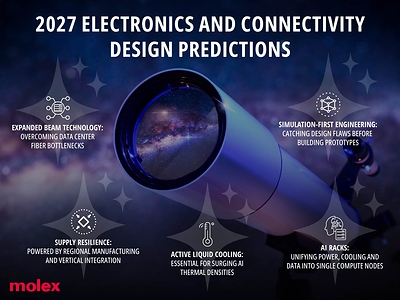
The AI rack will quickly become the foundational unit of modern computing. As data center density escalates, performance will hinge on how efficiently the rack moves data, delivers power and removes heat. Designing compute, networking, busbars, power delivery and thermal management into a unified system is intended to help increase useful AI output per watt. While GPU performance provides the engine, the interconnect fabric and power/thermal infrastructure will dictate reliable, sustained operation, with solutions like Molex Multi-Channel Liquid Cooled Busbars that integrate liquid cooling into the power backbone.
2. Simulation-First Engineering Will Replace Trial-and-Error
Facing unyielding compression in development cycles, engineering teams will increasingly adopt a more proactive Model-Predict-Optimize-Validate approach, combining simulation, AI-assisted design and engineering knowledge to identify problems earlier. Physical testing will remain critical, but more of the learning will happen before the first prototype is built.
3. Thermal Density and Power Constraints Drive Active Liquid Cooling
As AI workloads intensify and next-generation GPUs and ASICs push thermal densities beyond the practical limits of conventional air cooling, active liquid cooling will become increasingly critical to data center performance and reliability. Innovations such as CAEPlus’ proprietary BoundaryCool™ platform, supported by Molex’s recent investment, will help address escalating thermal challenges. Combining active thermal technologies with operational safeguards, like OCP-compliant dry-break interfaces and leak-detection telemetry, will also become essential to prevent downtime.
4. Optical Interconnects and EBO Technology Will Scale to Overcome Fiber Bottlenecks
As AI training clusters exponentially multiply network fiber counts, data center architectures must expand beyond traditional rack-to-rack “scale-out” into chip-to-chip “scale-up” and campus-wide “scale-across” connectivity. To manage this density without the risks of encountering dust, debris and inspection bottlenecks, zero-touch Expanded Beam Optics (EBO) technology will dominate, cutting deployment, inspection and maintenance overhead by up to 85%. The new Molex VersaBeam Mini delivers 3x density improvements in an ultra-compact form factor, while the recent acquisition of Teramount Ltd. brings detachable, fiber-to-chip connectivity designed for high-volume Co-Packaged Optics (CPO) and silicon photonics.
5. Humanoid Robotics and Physical AI Continue to Move from Prototypes to Mass Production
Humanoid robotics, robotic-assisted surgical systems and advanced automation will successfully move from R&D prototypes to commercial-scale manufacturing. To overcome severe space constraints with multi-axis joints, engineers will seek solutions that route power and high-speed data through tight channels with precision. Growing momentum for hybrid interconnect solutions, like the Molex MiniMix Hybrid Power and Signal Connectors, solves this problem by integrating 15.0A power and 1Gbps Ethernet into an ultra-compact 5.65mm routing profile. This slashes the routing area by up to 50% to accelerate mass-production scaling.
6. Defense Modernization Will Accelerate Need for Autonomous, Modular, High-Power Platforms
Facing aggressive tailwinds and demands for rapid modernization, the military will prioritize autonomous and edge-AI platforms. As more data-heavy workloads migrate to the tactical edge under tight Size, Weight, Power and Cost (SWaP-C) constraints, engineers will rely on rugged, modular hybrid interconnect systems, like the AirBorn SInergy Modular High-Speed Hybrid Connector. Combining up to 25.0A power, 25Gbps data rates, and 40 GHz RF contacts delivers all-in-one connectivity while reducing supply-chain complexity.
7. The New Space Economy Will Drive Demand for Commercial Speed and Flight-Proven Agility
Driven by commercial space disruptors like SpaceX and Blue Origin, the new space economy is changing product lifecycles. Rapid-iteration architectures and Commercial Off-the-Shelf (COTS) components let market entrants shrink development timelines from years to months. Space-rated, radiation-resistant optical transceivers, such as the SpaceABLE 28G from Smiths Interconnect, a Molex company, enable high-bandwidth, low-SWaP connectivity to support the growing data demands of testing next-gen satellites and space-based applications.
8. The New Supply Chain Network Effect Requires Prioritization of ‘Customer Request Dates’
Amid shifting trade policies, geopolitical tensions and chronically constrained component allocations, companies will need to replace traditional supply networks with intelligent digital supply chains that prioritize “customer request dates.” The adoption of adaptable, intelligence-driven operating models using generative and agentic AI workflows built on trusted data foundations will help companies optimize fulfillment based on real-time demand urgency, customer segmentation and dynamic routing.
9. Talent and Mindset Transformations Will Propel Cross-Industry Convergence
Industry leadership will increasingly depend on cultivating workforce enablement and scaling engineering productivity. Organizations that scale knowledge transfer, accelerate talent onboarding and leverage automation-assisted decision-making will hold a competitive edge. At the same time, traditional industry silos must dissolve so that teams can cross-pollinate innovations to solve extreme design challenges. A prime example is enabling the next generation of more complex, minimally invasive medical devices, such as electrophysiology catheters that deliver pulse field ablation to patients with atrial fibrillation using innovative Molex EdgeStack and TheraVolt medical connectors. These new technologies are addressing the convergence of high-voltage therapy delivery, dense signal connectivity and continued miniaturization.
10. Regional Footprints and Vertical Integration are Needed to Bolster Supply Resilience
To insulate operations against global trade volatility, industry leaders will scale regional manufacturing hubs, giving customers optionality to mitigate tariff, freight and other operational risks. Molex’s new high-tech plant in Hung Yen, Vietnam, exemplifies this trend. Coupled with deeper vertical integration of raw materials, ferrules, and specialized cabling—underpinned by Molex’s strategic agreement with Prysmian to double domestic fiber capacity—these localized production networks will offer companies much-needed supply assurance and long-term business continuity.
About Molex
Molex is a global electronics leader committed to making the world a better, more-connected place. With a presence in more than 40 countries, Molex enables transformative technology innovation in the consumer device, aerospace and defense, data center, cloud, telecommunications, transportation, industrial automation and healthcare industries. Through trusted customer and industry relationships, unrivaled engineering expertise, and product quality and reliability, Molex realizes the infinite potential of Creating Connections for Life. For more information, visit www.molex.com.

 View original content to download multimedia:https://www.prnewswire.com/news-releases/molex-forecasts-top-10-connectivity-and-electronics-predictions-for-2027-powered-by-ai-simulation-first-engineering-and-system-level-optimization-302934068.html
SOURCE Molex Incorporated