Mundoro Reports 2026 Timok Exploration Results; BHP Continues Trstenik and South Timok Options; Mundoro Regains 100% of Central Timok and Borsko Properties with Five Drill-Ready Porphyry Targets
Vancouver, British Columbia–(Newsfile Corp. – November 6, 2026) – Mundoro Capital Inc. (TSXV: MUN) (OTCQB: MUNMF) (www.mundoro.com) (“Mundoro” or the “Company”) is pleased to report the exploration results and technical advances achieved during the first nine months of 2026 across its licenses in the Timok Magmatic Complex (“Timok”), Serbia, and to provide an update on its option agreements with BHP.
2026 BHP Funded Exploration Program Highlights
-
Drilling across four targets. 4,438 m of diamond drilling, including a 495 m extension of hole 23-VIT-01, returned geological vectors supporting follow-up at Skorusa East and Tilva Rosh South; Vitanovac results are pending assay review.
-
New geophysical imaging. AMT survey over approximately 178 km² with a 3D resistivity model, plus a 1,131-station ground gravity survey; interpretation in progress.
-
Seven porphyry targets, five drill-ready. Re-logging produced a new interpretation of target areas that remain untested by drilling; all seven are on the Central Timok and Borsko programs. Drill-ready: Borsko Target 1, Tilva Rosh North, Tilva Rosh South, Skorusa West and Skorusa East. In targeting phase: Skorusa North and Borsko South.
-
Borsko Target 1: concealed porphyry, open to the southeast. A-type stockwork in 17-BJ-11; four holes proposed to test this target.
-
Tilva Rosh North: untested potassic core. Re-logging of nine historical holes maps the outer zones of a porphyry system; four holes proposed.
-
Skorusa West: vectors toward a porphyry centre. Intermineral dykes, A-type veins and potassic alteration in historical core; three holes proposed.
-
Upgraded logging standard across the district. 20,000+ m re-logged and 19,000+ m hyperspectrally scanned; geochemical vectoring has been refined. The program was designed to improve targeting and has done so, identifying features not recognised in prior core reviews and providing the geological detail needed for vectoring.
-
BHP option agreements. “BHP Group Limited, through its wholly owned subsidiary, BHP Billiton (UK) DDS Limited (“BHP”)”, has funded approximately CAD $18.9 million (US$13.4 million)4 of combined exploration across all four of the Company’s Timok programs from January 2023 to September 30, 2026. BHP has incurred the exploration expenditures required under the option agreements for the Trstenik and South Timok programs, having funded approximately CAD $10.9 million (US$7.8 million)4 of exploration on the two programs to September 30, 2026. Both options remain in good standing, with a Work Program and Budget in place through BHP’s fiscal year ending June 30, 2027. BHP may now exercise at any time each option independently. On exercise of an option, BHP would acquire a 100% interest in the relevant licenses, and Mundoro would retain a 2% net smelter return royalty and receive annual advance royalty payments and development milestone payments1. BHP has provided notice of termination to Mundoro in accordance with the applicable option agreement in respect of the Central Timok and Borsko programs. BHP funded approximately CAD $8.0 million (US$5.7 million)4 of exploration on these programs to September 30, 2026. The eight licenses that make up the Central Timok and Borsko programs remain 100% owned by Mundoro and, on termination, will be free of the BHP options. The Company intends to seek one or more new partners for these licenses.
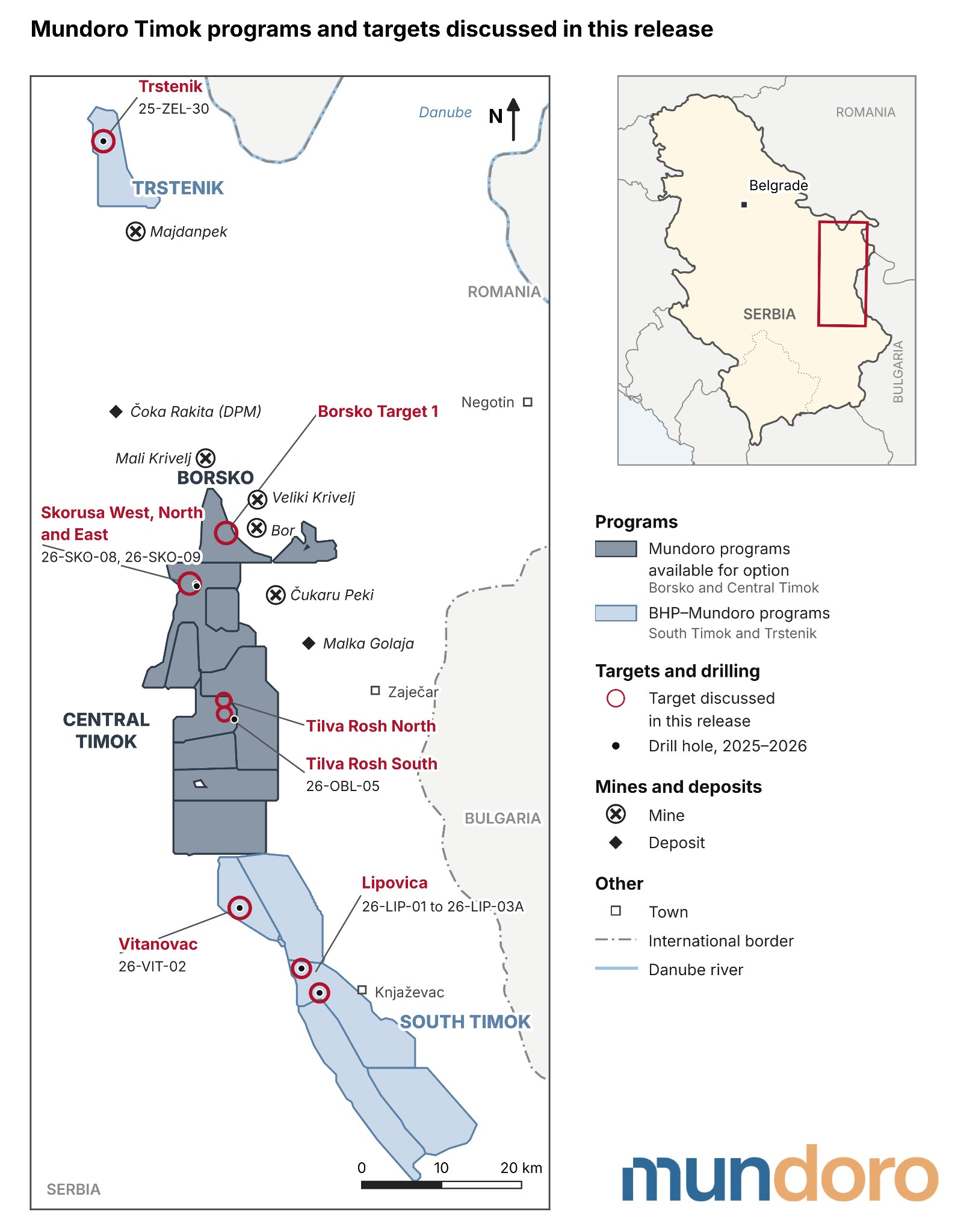
Figure 1 – Location of the Company’s Timok programs, showing the Trstenik and South Timok programs (BHP options continuing), the Central Timok and Borsko programs (available for partnering), and the targets discussed in this release
To view an enhanced version of this graphic, please visit:
https://images.newsfilecorp.com/files/2408/322850_01041036042d38c7_001full.jpg
Teo Dechev, Chief Executive Officer, President and Director, stated: “Our partnership with BHP continues on two of the four Timok programs. At Trstenik and South Timok, BHP has met the expenditure requirements under its options, may exercise at any time now, and has a Work Program and Budget in place, and we look forward to continuing that work together. We thank BHP for its investment in the Central Timok and Borsko programs. Its funding of approximately CAD $8.0 million4 of exploration on these licenses advanced seven targets, five of which now have drill proposals. With BHP’s notice to terminate those options, these licenses will be free of the BHP options, and Mundoro retains 100% ownership along with all of the data and knowledge generated. We now look to carry that work forward with new partners, as partnerships remain central to how Mundoro advances exploration towards discovery.”
Humberto Brockway, Director of Exploration at Mundoro stated: “Our focused exploration this year-combining targeted drilling, expanded geophysical surveys, and rigorous re-logging of over 20,000 metres of historical core-has transformed our technical understanding of the Timok portfolio. Re-logging identified porphyry veining, intermineral dykes and potassic alteration in historical holes where they had not been recognized in the original logging. These insights led directly to seven targets, five of which now have drill proposals in place. Advanced targets such as Borsko Target 1, Tilva Rosh North, and Skorusa West are prime candidates for the next phase of validation.”
BHP Option Status and Partnering Opportunity
The eight licenses within the Central Timok and Borsko programs cover over 20 target areas over 458.5km² in the central part of the Timok Magmatic Complex, the belt that hosts the Bor and Majdanpek copper mines and the Čukaru Peki deposit. (See Figure 2)
A partner entering these licenses would have access to drill proposals for five targets, previously drilled core over various campaigns now re-logged to a single district standard, hyperspectral core scans, a 3D AMT resistivity model, ground magnetics, gravity and passive seismic data and integrated 3D target models.
Mundoro intends to commence discussions with third parties regarding new option or joint venture arrangements for these licenses. The Company will report on the status of these discussions in its quarterly filings and will announce any agreement when it is entered into.
Mundoro and BHP entered into option agreements covering four (4) programs in Timok (see prior news release links in References). The status of each program is summarized in Table 1.
Table 1 – BHP option status by program
| Program | Licenses | Targets discussed in this release | Status |
| Trstenik | Trstenik, Crvena Zemlja | Trstenik SW; Trstenik Central-North | Option ongoing and in good standing; expenditure requirements met; Work Program and Budget through June 2027; BHP makes annual option payments and ongoing operator fees |
| South Timok | Lipovica, Orlovac, Vitanovac, Ponor | Lipovica; Vitanovac | Option ongoing and in good standing; expenditure requirements met; Work Program and Budget through June 2027; BHP makes annual option payments and ongoing operator fees |
| Central Timok | Branik, Skorusa, Oblez, Bobot, Odej, OdejSouth, Gramada | Tilva Rosh North and South; Skorusa West, North and East | Notice of relinquishment received; 100% Mundoro; available for partnering |
| Borsko | Ruzana | Borsko Target 1; Borsko South | Notice of relinquishment received; 100% Mundoro; available for partnering |
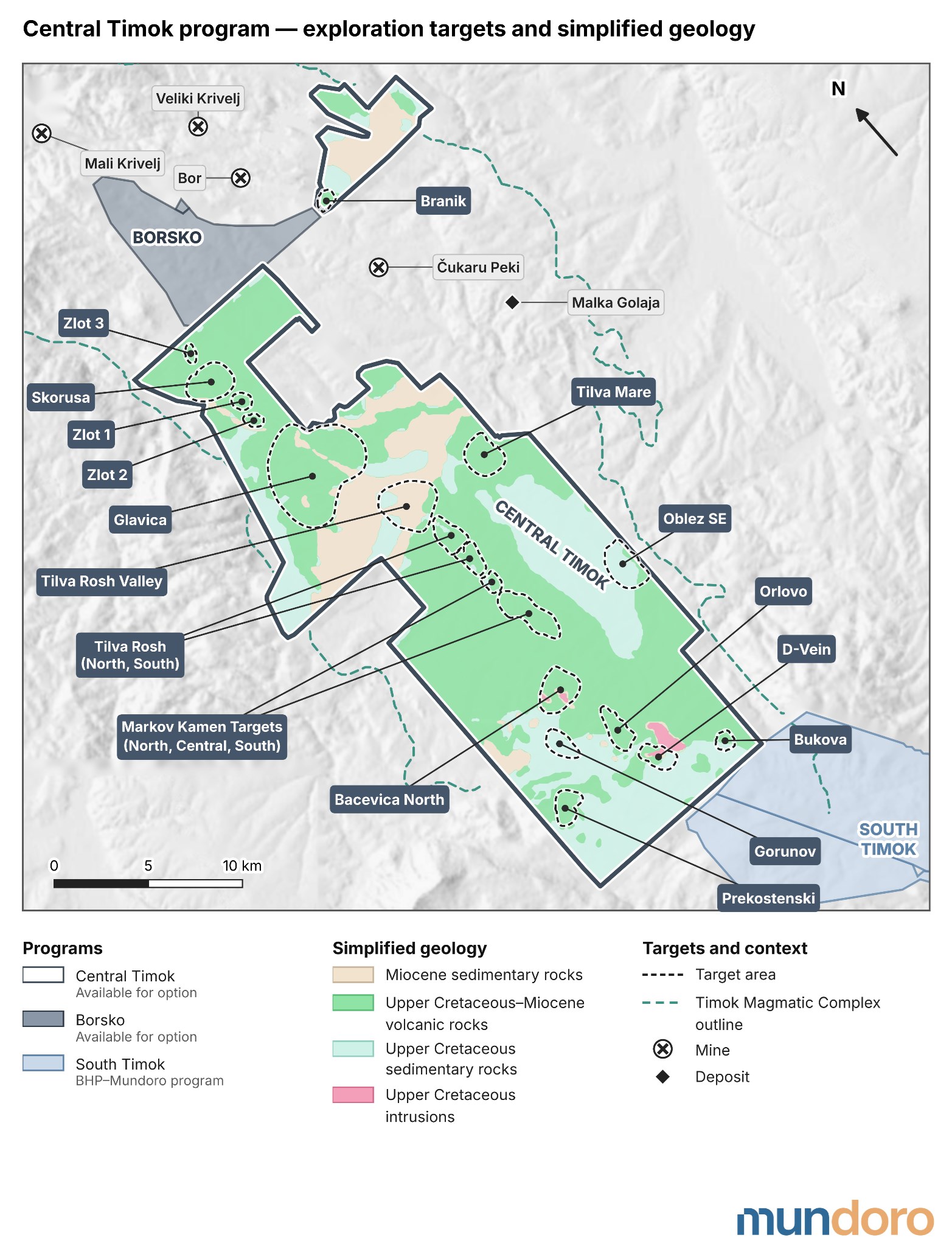
Figure 2 – Central Timok Licenses showing exploration targets, simplified geology, and nearby mines and deposits, with the Borsko and South Timok licenses for context
To view an enhanced version of this graphic, please visit:
https://images.newsfilecorp.com/files/2408/322850_01041036042d38c7_002full.jpg
Key Insights from 2026 Integrated Exploration
The integration of new geophysics (audio-magnetotellurics and ground gravity), standardized district-scale re-logging, and systematic re-categorization of drill core observations delivered key advances in mapping alteration zoning, vein density distributions, and intermineral intrusive phases. Rather than evaluating anomalies in isolation, this comprehensive approach enabled the Company to construct cohesive 3D target models, advancing seven targets, five of them to the drill-proposal stage. Results from the 2026 drilling in the Central Timok program3, at Skorusa East and Tilva Rosh South, returned geological vectors that justify follow-up drill testing. Results from the South Timok and Trstenik programs, where BHP’s options continue, are reported separately below.
Table 2 – Targets advanced in 2026 (all on the Central Timok and Borsko programs)
| Target | Key evidence from re-logging and drilling | Status / proposed next phase |
| Borsko Target 1 | A-type quartz stockwork with vein truncations in 17-BJ-11; advanced argillic overprint; V/Sc and Sr/Y consistent with fertile magma; interpreted open to the southeast | 4 proposed holes |
| Tilva Rosh North | Zoning from lithocap into porphyry periphery; A-type veins in FMSC19014 and 22-BOB-02; porphyry intrusive at 623-750 m in 22-BOB-02 | 4 proposed holes (TRN-P01 to TRN-P04) |
| Tilva Rosh South | Distal porphyry signature at 803-861 m in 26-OBL-05 indicates the alteration vector towards potassic center to the west of hole FMSC18006 | 6 proposed holes (TRS-P01 to TRS-P06) |
| Skorusa West | Intermineral diorite porphyry dykes; A-type veins cutting quartz-magnetite veins; potassic outcrop with soil Cu above 300 ppm | 3 proposed holes (SKW-P01 to SKW-P03) |
| Skorusa East | Lithocap level confirmed by 26-SKO-08 and 26-SKO-09; Cu and Cu/Zn rising with depth | 2 proposed deeper holes (SKE-P01 and SKE-P02) |
| Skorusa North | STDD007 potassic from 55 m to end of hole with 1-3 B-type veins per metre; 21-SKO-03 ends in potassic alteration | Targeting ongoing; no holes designed yet |
| Borsko South | Re-logging of the southern hole clusters (6 of 7 holes complete) | Re-logging nearing completion; targeting ongoing |
Central Timok and Borsko Programs (Available for Partnering): Discussion of Prospects for Drilling
Borsko Target 1
In March 2026, a revised geochemical interrogation of assay data led to the interpretation that Target 1 was a weakly mineralised lithocap shoulder, with the porphyry core probably outside the drilled area. Re-logging of the deep intervals of nine historical holes reversed that view. Hole 17-BJ-11 contains A-type quartz veinlet stockwork with vein truncations and refractory vein fragments, interpreted as evidence of a multi-phase porphyry intrusion. These porphyry veins are strongly overprinted by later advanced argillic alteration (quartz-alunite-dickite core and kaolinite-pyrite halos). This overprint made recognition of porphyry veins difficult and they were not recognized in the original logging.
The system is interpreted to lie beneath approximately 400-450 m of fresh to locally altered, north-dipping volcaniclastic cover. It appears to close off to the northwest and remains open to the southeast, where it is projected to rise to shallower levels (Figure 5). Whole-rock fertility ratios (vanadium/scandium and strontium/yttrium) are consistent with fractionated, porphyry-fertile magma. The Borsko corridor extends approximately 8 km northwest-southeast, parallel to the Bor corridor, and the re-logging suggests it may host more than one centre. The integrated model combines the re-logging with ground magnetics (3D MVI), CSAMT and passive seismic data. It recommends at least four holes of 1,500 m each to test the area southeast of 17-BJ-11 (Figures 3 and 5).
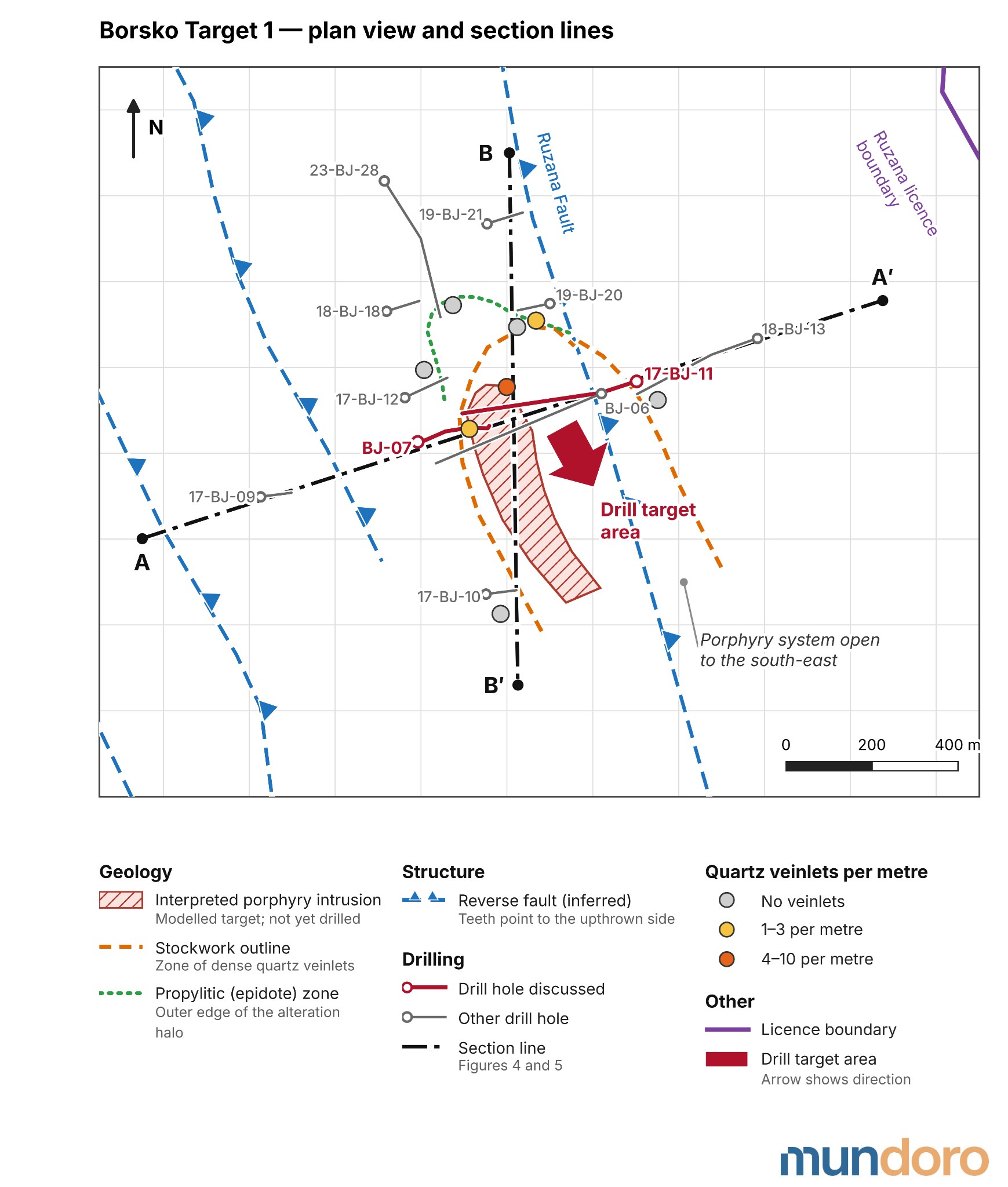
Figure 3 – Borsko Target 1 plan view showing drill holes, the interpreted porphyry intrusion, the quartz-veinlet stockwork outline, inferred reverse faults and the locations of sections A-A′ and B-B′
To view an enhanced version of this graphic, please visit:
https://images.newsfilecorp.com/files/2408/322850_01041036042d38c7_003full.jpg
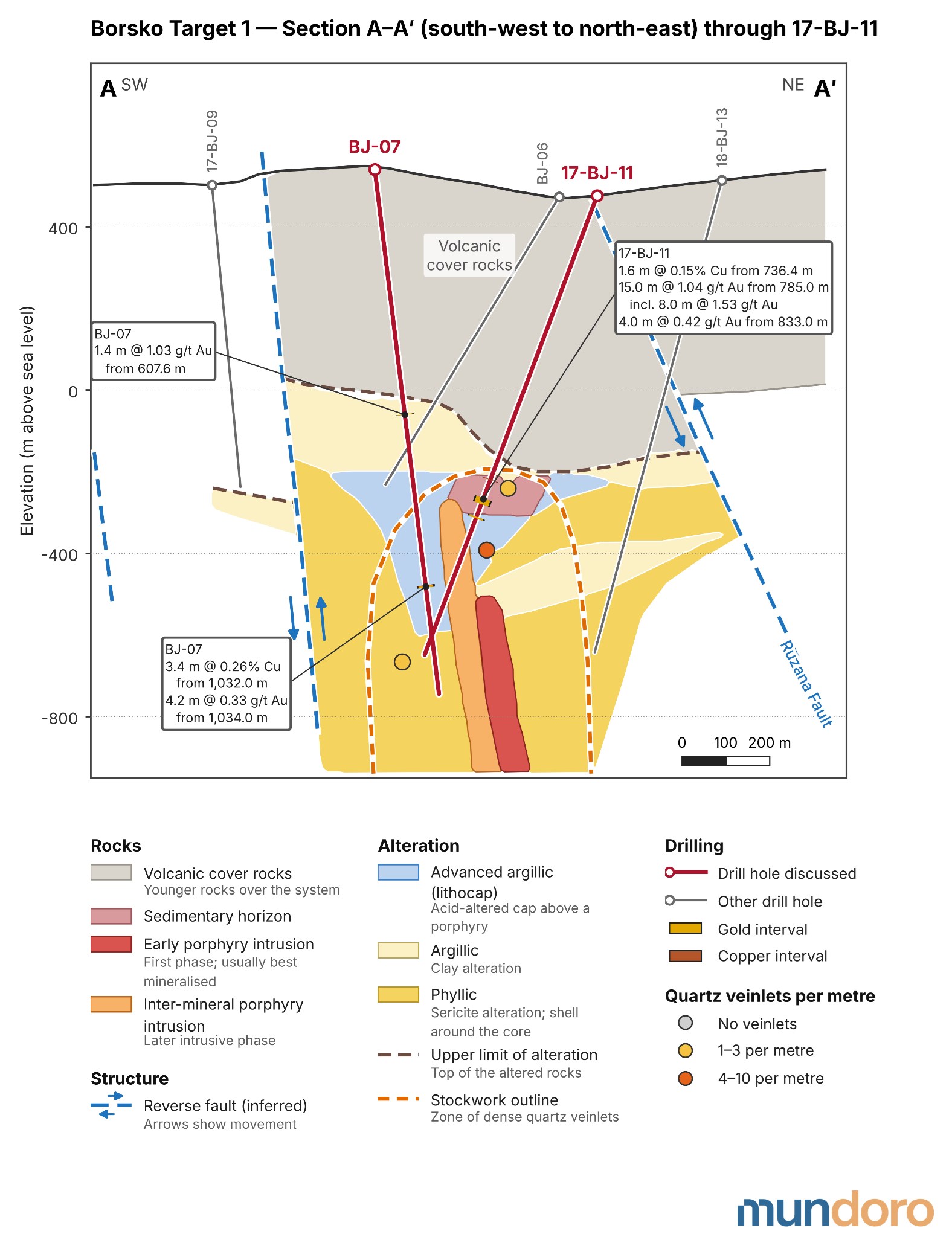
Figure 4 – Borsko Target 1 section A-A′ (south-west to north-east) through 17-BJ-11 showing vein and alteration zoning and drill intercepts
To view an enhanced version of this graphic, please visit:
https://images.newsfilecorp.com/files/2408/322850_01041036042d38c7_004full.jpg
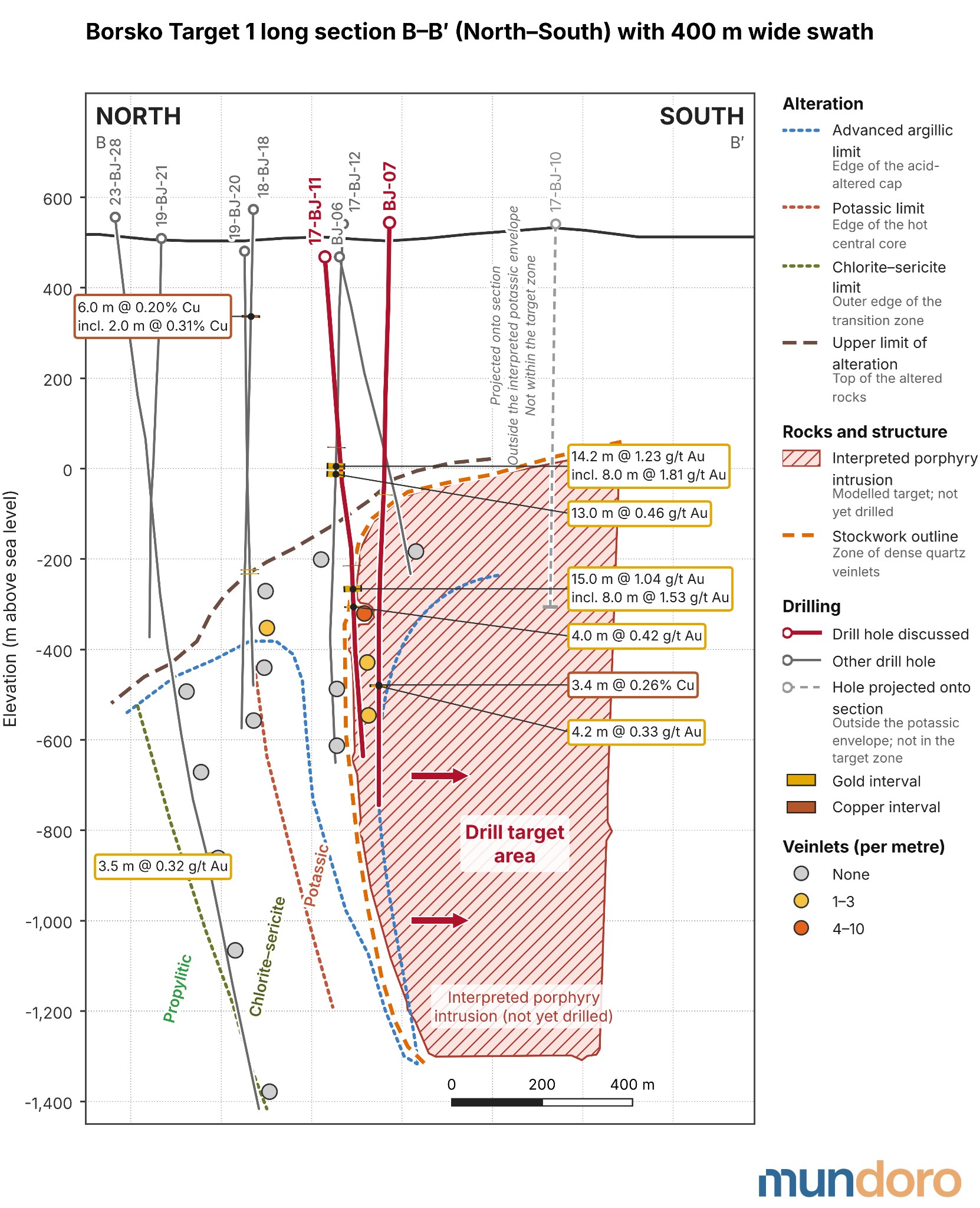
Figure 5 – Borsko Target 1 long section B-B′ (north-south) with 400 m swath, showing alteration zoning, vein density, drill intercepts and the drill target area
To view an enhanced version of this graphic, please visit:
https://images.newsfilecorp.com/files/2408/322850_01041036042d38c7_005full.jpg
Tilva Rosh North
Ten historical holes totaling 7,700.5 m have been drilled at Tilva Rosh North. Nine of them (7,409.5 m) were re-logged to the new standard in August and September 2026. The re-logging defines a zoning pattern across the target:
-
23-BOB-04 (far north) is distal, showing no quartz veins.
-
STDD001 (northeast margin) is drilled in the quartz-alunite-kaolinite upper lithocap.
-
FMSC19014 passes from epithermal veining into the top of a porphyry system, with A-type veins from 381 m to the end of the hole at 574 m.
-
22-BOB-02 passes through sericite alteration into A-type veins beneath an advanced argillic overprint (425-623 m), then into diorite-monzodiorite porphyry (623-750 m) with up to 10 veins per metre, that includes quartz-magnetite veinlets in partially preserved potassic alteration.
The Company interprets these holes as peripheral to a potassic, copper-rich core that has not been tested at depth. Core re-logging included re-examination of hole 22-BOB-01. At least two phases of intermineral to late porphyry dykes, with a well-developed quartz stockwork of A-veins consisting of pyrite, chalcopyrite and magnetite, are hosted in volcanic breccias, exhibit potassic alteration with a moderate to strong sericite-chlorite overprint, and have been intersected from 435.5 m to 544 m. Other historical drilling shows quartz stockwork in volcanic host rock, with dominant sericite-chlorite and remnant potassic alteration, to the south, whereas propylitic and sericitic alteration without quartz stockwork has been found immediately to the north.
A proposed four-hole program (TRN-P01 to TRN-P04) has been designed from the alteration zoning mapped by re-logging and from interpreted magnetic (MVI) and resistivity/chargeability (CSAMT) sections. They target the area between 22-BOB-01 and 23-BOB-05, northwest of 22-BOB-02, and north and northeast of FMSC19014. Each hole is planned at an azimuth of 090° and a dip of −75° to a depth of 1,000 m (Figures 6 and 7).
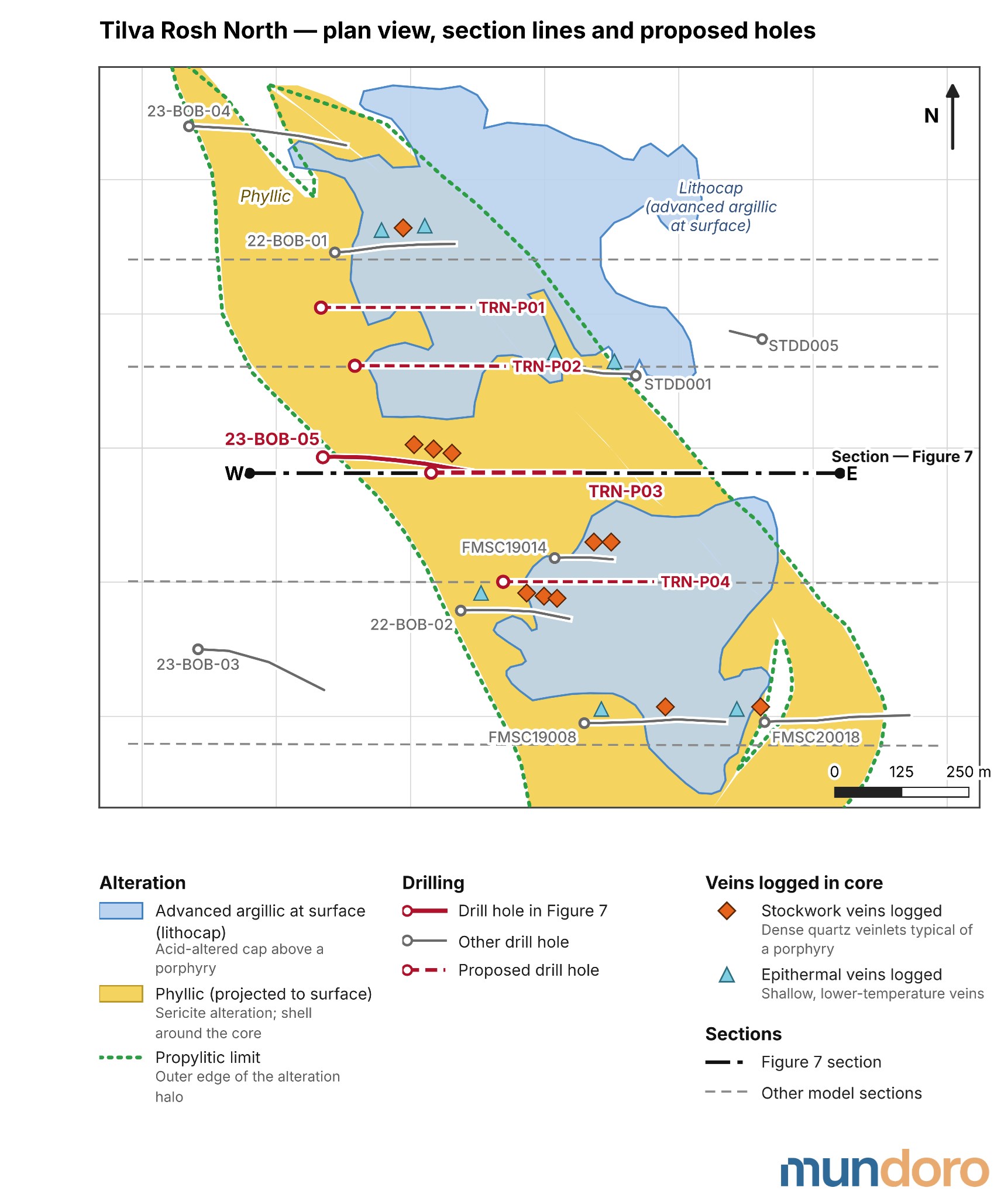
Figure 6 – Tilva Rosh North plan view showing drill holes, surface alteration, the section line for Figure 7 and proposed holes TRN-P01 to TRN-P04
To view an enhanced version of this graphic, please visit:
https://images.newsfilecorp.com/files/2408/322850_01041036042d38c7_006full.jpg
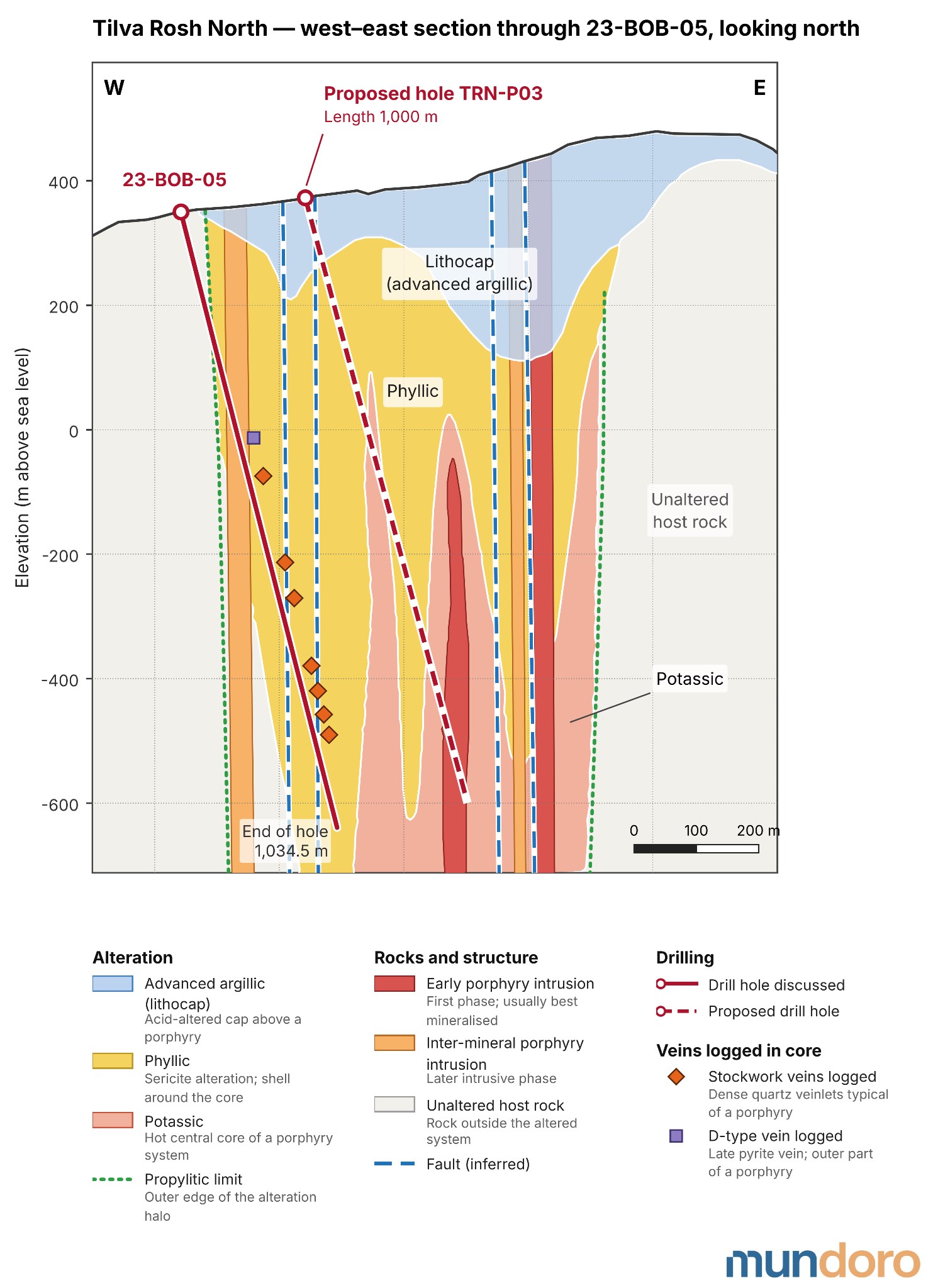
Figure 7 – Tilva Rosh North west-east section through 23-BOB-05 showing re-logged alteration and vein zoning and proposed hole TRN-P03.
To view an enhanced version of this graphic, please visit:
https://images.newsfilecorp.com/files/2408/322850_01041036042d38c7_007full.jpg
Skorusa West and North
Earlier drilling at Skorusa West returned broad, low-grade copper-gold intervals. These include: 60.0 m at 0.14% Cu and 0.31 g/t Au from 54.0 m in SUMDD002 and 56.0 m at 0.15% Cu and 0.16g/t Au from 329.0 m in 21-SKO-04 . Re-logging of core from Skorusa West showed two previously unidentified features:
- intermineral diorite porphyry dykes with biotite-magnetite-K-feldspar alteration in holes 21-SKO-04, STDD002 and SUMDD002
- quartz-magnetite veins cut by A-type quartz-sulphide veins in hole SUMDD001
These features are significant in that they typically lie closer to the centre of a porphyry system.
In the same area, at surface, a magnetic high coincides with exposed potassic alteration and copper in soils above 300 ppm, flanked to the north and south by molybdenum in soils above 5 ppm. Reprocessed spectral data show a white-mica cluster with a clay halo west-northwest of the potassic outcrop. Four target areas have been defined at Skorusa West and three holes are proposed (SKW-P01 to SKW-P03) based on the recently updated geological model.
At Skorusa North, hole STDD007 is potassically altered from 55 m to the end of the hole at 401.8 m, with one to three B-type veins per metre between 100 m and 350 m, and 21-SKO-03 ends in potassic alteration at 550-600 m. B-type veins typically form within or close to the potassic core of a porphyry system and commonly carry copper and molybdenum sulphides. Skorusa North is ranked at the target-testing stage, meaning it has enough supporting data to justify drilling; hole design is ongoing.
Skorusa East
Skorusa East was drilled in April and May 2026 to test the interpretation of an exposed potassic core. Holes 26-SKO-08 (499.8 m) and 26-SKO-09 (788.3 m) intersected advanced argillic, quartz-sericite-pyrite and quartz-clay breccia alteration with polymetallic veins, but no A- or B-type porphyry veins. The holes are interpreted to have been drilled through the lithocap and upper levels of a porphyry system.
Copper and molybdenum background levels and the Cu/Zn ratio rise with depth. Selected results, in downhole order:
-
26-SKO-08: residual quartz with polymetallic veins from 46.0 m to 54.1 m averages 0.14% Pb, 0.30% Zn and 73 ppm Mo.
-
26-SKO-08: quartz-pyrite-molybdenite veins from 358.0 m to 362.0 m average 235 ppm Mo.
-
26-SKO-09: the 64.0 m interval from 416.0 m to 480.0 m averages 0.048% Cu and hosts three shorter copper intervals: 6.0 m at 0.12% Cu from 416.0 m, 6.0 m at 0.14% Cu from 426.0 m and 1.5 m at 0.35% Cu from 476.5 m.
-
26-SKO-09: 3.7 m at 1.37 g/t Au from 482.3 m, including 2.0 m at 1.90 g/t Au from 484.0 m.
-
26-SKO-09: the best copper interval, 22.3 m at 0.12% Cu from 689.7 m, including 2.0 m at 0.30% Cu from 698.0 m, lies near the bottom of the hole in silica-pyrite-sericite-clay alteration with disseminated chalcopyrite.
Based on the updated model, two deeper holes (SKE-P01 and SKE-P02) are proposed.
Tilva Rosh South
Hole 26-OBL-05 was drilled from the Oblez license to 1,302.7 m in mid-2026. It tested a coincident MVI and CSAMT chargeability high (Target 3) east of historical hole FMSC18006. The hole passed through three zones:
- fresh volcaniclastic rocks to approximately 805 m
- a fractured interval with fault gouge and sooty pyrite from 805 m to 923 m
- propylitic (epidote-chlorite) alteration from 923 m to the end of the hole
Assays have now been received for the full hole, and no significant intervals were returned. Maximum values for the hole were 2,490 ppm Cu, 0.216 g/t Au and 49.6 ppm Mo. Between 803 m and 861 m, low-temperature sooty pyrite carries slightly elevated arsenic, gold, tellurium, lead and zinc (gold up to 0.08g/t, lead up to 280 ppm and zinc up to 578 ppm). This is interpreted as a distal zone of a porphyry system.
Core re-logging of FMSC18006 at Tilva Rosh South indicates the presence of advanced argillic alteration capping consisting of a kaolinite-pyrite assemblage up to 148 m depth, then transitioning into sericite alteration. Quartz veining consisting of smoke quartz (Maricunga Type) is well developed at the upper part, possibly related to the epithermal alteration, down to 200 m, and minor early A-type veins are observed from 150 m. The host rock comprises fine porphyritic volcanic breccias and coherent fine diorite. At the bottom approximately 840 m the alteration changes into chlorite-sericite dominant with remnants of potassic alteration. A late phase porphyry dyke exhibits chlorite-sericite and traces of epidote and low copper grades.
Borsko South
Re-logging of the southern holes at Borsko is nearing completion, with six of seven holes done (3,614.8 m of 4,616.8 m).
South Timok and Trstenik Programs (BHP Options Continuing): 2025-2026 Drilling
Drilling in 2025 and 2026 within the South Timok and Trstenik programs, where BHP options continue, comprise stratigraphic holes at Lipovica and Vitanovac and a first, partial test of the Trstenik Central-North target. Exploration on these programs continues under BHP’s Work Program and Budget through June 2027.
-
Lipovica target (South Timok). The Lipovica holes were stratigraphic holes designed to constrain the thickness of both the post-mineral cover and the target Late Cretaceous volcanics below. Although neither hole reached its target depth, both provided important constraints on the thickness of Paleogene and Miocene cover, improving our ability to model depth to prospective stratigraphy across the licences, and to identify targets at economic depths beneath cover.
-
Central-North target (Trstenik). Trstenik Central North was only partially tested due to operational constraints. The hole drilled intersected Late Cretaceous porphyritic andesite dykes of the same age as the Majdanpek porphyry system, demonstrating that magmatism of this age extends along important arc-parallel structures through the Trstenik licence. The target therefore remains incompletely tested and further drilling would be required to fully assess its potential.
-
Vitanovac target (South Timok). The Vitanovac hole was also stratigraphic, designed to test whether thrusting had resulted in repetition of the stratigraphic sequence. While no thrust repetition was demonstrated, drilling showed that some sedimentary units were substantially thicker than previously modelled. This is an important constraint that will directly inform modelling and future targeting in this part of the belt.
Next Phase of Work
The next phase is designed to validate the partly-tested targets and to bring the rest of the portfolio to the same standard:
-
Validation drilling. Drill proposals are in place for Borsko Target 1, Tilva Rosh North, Skorusa West, Skorusa East and Tilva Rosh South, all on the Central Timok and Borsko licenses. Drilling of these targets will depend on the Company entering into agreements with new partners.
-
Datasets pending integration. These comprise interpretations of the hyperspectral scanning, AMT data, and gravity data over Skorusa, Oblez and Borsko, as well as assays and geochronology for 26-VIT-02, and the age dating and fertility samples dispatched in August 2026 from the Gramada, Odej South, Skorusa and Bobot (Tilva Rosh) prospects, and zircon dating of the Trstenik Central-North dykes in 25-ZEL-30.
-
Generative work. This includes reconnaissance mapping of the Skorusa south-east zone through to December 2026 and preparation of the minimum work commitment program for the Branik license.
Reporting of Exploration Results
The Company reports an interval as significant where it grades more than 0.2% Cu or 0.2 g/t Au over at least 5 m downhole, with no more than 2 m of consecutive internal dilution. None of the 2026 drill intervals meet this threshold, and they are reported for their geological and vectoring significance. Intervals are calculated at a 0.1% Cu cut-off, or 0.2 g/t Au where gold occurs without copper, with up to 2 m of internal dilution; grades are length-weighted and uncut, lengths are downhole and true widths are not known. The 26-SKO-08 and 26-SKO-09 intervals supersede those reported on August 31, 2026.
Historical intervals for Skorusa West (SUMDD002 and 21-SKO-04) and Borsko (Figures 4 and 5) are from drilling completed by the Company and its previous partners and were previously reported by the Company; the Skorusa West intervals are composited over logged intervals. Descriptions of alteration, veining, intrusive phases and spectral mineralogy are qualitative observations from core logging and are not assay results.
Quality Assurance and Quality Control
Sampling and analytical work on the 2026 drill holes was carried out under the supervision of the Qualified Person and in accordance with industry standard practice. Drill core was cut in half by diamond saw, with one half submitted for analysis and the other retained on site for reference. Samples were prepared and analysed by ALS, with sample preparation at ALS Bor (Serbia) and analysis at ALS Rosia Montana (Romania) and ALS Loughrea (Ireland). ALS is independent of the Company and these laboratories are accredited to ISO/IEC 17025.
Multi-element analyses, including copper, were completed by ALS method ME-MS61L (four-acid digestion with ICP-MS finish) and gold by method Au-AA24 (50 g fire assay with AAS finish), with over-limit results re-assayed by Au-GRA22 for gold and OG62 for base metals. Certified reference materials and blanks were inserted alternately into the sample stream at a rate of one in every 20 samples, and field duplicates at a rate of one in every 25 samples, in addition to the laboratory’s internal quality control procedures. All quality control results were reviewed by the Qualified Person and were found to be within acceptable limits.
Continuous hyperspectral core scanning was carried out with a handheld hyperspectral scanner at a 3.5 mm step, and point spectral measurements were collected at 1 m intervals and interpreted using industry standard software.
Qualified Persons
The scientific and technical information in this news release has been prepared in accordance with National Instrument 43-101 – Standards of Disclosure for Mineral Projects. The scientific and technical information has been reviewed and approved by Humberto Brockway, EurGeol, Qualified Person as defined by NI 43-101 and Director of Exploration to the Company. Mr. Brockway is not independent of the Company.
About Mundoro
Mundoro is a Canadian mineral acquisition, exploration, development, and investment company with a portfolio of mineral properties focused primarily on base and precious metals. To drive value for shareholders, Mundoro’s asset portfolio generates near-term cash payments to Mundoro and creates royalties attached to each mineral property optioned to partners. The portfolio of mineral properties is currently focused on predominantly copper in two mineral districts: Western Tethyan Belt in Eastern Europe and the Laramide Belt in the southwest USA.
ON BEHALF OF THE BOARD OF DIRECTORS OF MUNDORO,
Teo Dechev,
Chief Executive Officer, President and Director
Follow us on social media: LinkedIn: https://ca.linkedin.com/company/mundoro-capital-inc | X: https://x.com/MundoroCapital
For further information about Mundoro, please visit our website at www.mundoro.com or contact:
Teo Dechev, Chief Executive Officer, President and Director
Michael Starogiannis, Business Development and Investor Relations
Company investor line: +1-604-669-8055, [email protected]
References
1 Mundoro Capital, January 23, 2023 news release: Mundoro Options to BHP Exploration Properties in Timok, Serbia. [Link]
2 Mundoro Capital, October 13, 2025 news release: Mundoro Announces Option Agreement with BHP for Exploration Licenses in Central Timok, Serbia. [Link]
3 Mundoro Capital, August 31, 2026 news release: Mundoro Reports Progress on Exploration Programs and Financial Results. [Link]
4 Calculated using a CAD/USD exchange rate of 1.4055 (US$1.00 = CAD $1.4055).
Cautionary Note Regarding Forward-Looking Statements
This news release contains forward-looking statements. Forward-looking statements can be identified by forward-looking words such as “will”, “expect”, “intend”, “plan”, “estimate”, “anticipate”, “believe”, or “continue”, or the negative thereof, and include statements regarding: the continuation of BHP’s options over the Trstenik and South Timok programs, any future exercise of those options and the royalty and payments the Company would receive; the termination of BHP’s options over the Central Timok and Borsko programs and its timing; the Company’s intention to seek and enter into agreements with new partners for the Central Timok and Borsko licenses; the interpretation of exploration results and of re-logging, geochemical, geophysical, hyperspectral, isotope and geochronological data; the interpreted presence, position, geometry and fertility of porphyry systems at Borsko Target 1, Borsko South, Tilva Rosh North and South, and Skorusa West, North and East; proposed drilling and the next phase of validation work, including the timing, scope, funding and approval of drill programs; the completion of the re-logging, hyperspectral interpretation, AMT, gravity and geochronology programs; the timing and receipt of outstanding assay results, including for hole 26-VIT-02; and execution of the Company’s existing plans and future business strategy. The material assumptions applied in making these forward-looking statements include expectations as to the mineral potential of the Company’s projects, continued access to and renewal of exploration licenses, the continuation of the Trstenik and South Timok options and the termination of the Central Timok and Borsko options on the terms described, the Company’s ability to enter into agreements with new partners on acceptable terms or to fund exploration itself, the availability of drilling and laboratory services, and the ability to fund and execute the exploration program. Actual results may differ materially from those expressed or implied by forward-looking statements. Factors that could cause actual results to differ include general economic and market conditions, exploration results and their interpretation, commodity prices, the risk that the Company does not enter into new partnership agreements on acceptable terms or at all, changes in law, regulatory processes, the status of Mundoro’s assets and financial condition, and the actions of competitors. Forward-looking statements contained in this news release are expressly qualified by this cautionary statement. Forward-looking statements are made as of the date of this news release and the Company undertakes no obligation to publicly update such statements, except as required by law. Shareholders are cautioned that all forward-looking statements involve risks and uncertainties; for a more detailed discussion refer to the Company’s filings with Canadian securities regulators available on SEDAR+ at www.sedarplus.ca.
Neither the TSX Venture Exchange nor its Regulation Services Provider (as that term is defined in the policies of the TSX Venture Exchange) accepts responsibility for the adequacy or accuracy of this release.

To view the source version of this press release, please visit https://www.newsfilecorp.com/release/322850